Sunday, March 10, 2013

THE PRAISE SERIES (Part 3) - PREVAILING THROUGH PRAISE

"From the lips of children and infants 
You have ordained praise because of your enemies 
to silence the foe and the avenger" 
Psalm 8:2


Throughout the book of Psalms David refers continually to his enemies. Few men had more enemies than David. Persistently they pursued him and surrounded him, seeking his destruction. He survived only because he learned the secret of dealing with his enemies. He did not meet them in his own power or wisdom. Rather, he evoked against them the presence and power of God.
One main way that he did was through PRAISE. This was the way God Himself ordained for David says' "From the lips of children and infants You have ordained praise ... to silence the foe and the avenger." In the natural order, children and infants are the weakest of all. But when praise comes from even the weakest, it's effect is powerful to silence the enemy and the avenger.
The Bible reveals that we too, like David, are surrounded by enemies, though ours are primarily in the unseen spiritual realm. The chief of these enemies is "the foe and the avenger" - Satan himself. He is the accuser of the brothers, the one who misrepresents us, who misinterpret everything we do, who even seeks to accuse us before the very throne of God.
How can we silence him? David has shown us the way: by PRAISE. When our praise ascends to God, it silences Satan. It cancels his accusations and shuts his mouth. It leaves us free to live out our lives without the continual condemnation of his accusations. Through praise we invoke the presence and power of God against all forces that oppose us.
(extract from "Through David's Psalms" - by Derek Prince)

For those of you who leads worship, try this ... there are times in the midst of praising the Lord, I would challenge the people of God to make a choice to open their mouth to proclaim the praise of God. I began to say that though they may be in the midst of diverse difficult circumstances to praise God, they could and should "put on the garment of praise for the spirit of heaviness (Isaiah 61:3)." I began to quote Psalm 8:2 and tell the congregation that even though their praises may be weak they are powerful to silence the enemies' accusations and intimidations. We begin to lift our voices, raise our hands and give a unanimous victory shout (Hallelujah!) ... very often we could immediately sense a spirit of victory and breakthrough. You could often "see" in the spiritual realm "the walls of Jericho and strongholds" collapse.

PRAISE is our power weapon to the pulling down of strongholds (Psalm 149: 6-9; 2 Corinthians 10:4)
* The enemies cringe when we PRAISE Him (Psalm 66:1-2)
* God inhabits in our PRAISE (Psalm 22:3)
Praise is born in faith, is an instrument of war and a method of creating an atmosphere for the presence of the Lord. Praise requires effort, will power and boldness  - TPWC

Monday, March 04, 2013

THE PRAISE SERIES (Part 2) - PRAISE UNCONDITIONALLY

Why do we praise God? Do we desire to honour Him and make Him glad? Or do we feel that praise puts God under obligation to grant the earthly longings we bring to Him in prayer? Will God do whatever we ask simply because we praise Him?
God is not a heavenly vending machine into which we insert the coin of praise, press the right button, and get whatever we want. Nor is praise is a magical incantation that forces God to fulfill our wishes. Many of us would not consciously try to manipulate God. But when we praise Him in the midst of a trial, we can be tempted to secretly bargain with Him, feeling in some recess of our heart, "I'm praising You, Lord. Now You owe it to me to work out this situation the way I want."


TRUSTING REGARDLESS OF WHAT HAPPENS
True praise imposes no condition on God. It chooses to believe Him regardless of the situation and it's outcome. It accepts the circumstances He has permitted, without insisting that He change them. Such praise begins with the attitude that says, "Father, I'm going to keep trusting You even though everything is dark and confusing." As we continue to praise, we reach the place where we can say, " Father, thank You that You are working in me to beautify my character. Don't remove this problem until You've done all You want to do through it, in me and in others. Use it to prepare me for the future You have in mind for me. Change me in any way You see fit."
One major purpose of trials is to strengthen our faith and transform our attitudes. Therefore choosing an attitude of trust and praise sometimes ends a trial with surprising speed. But even if it does not, we find ourselves enriched and strengthen to endure.
Daniel 3 tells the story of Shadrach, Meshach and Abednego, who refused to bow to the golden image of king Nebuchadnezzar. Hoping to dissuade them of their folly, the king said in a rage, "What god is there who can deliver you out of my hands?" They replied, "Our God whom we serve is able to deliver us from the furnace of blazing fire; and He will deliver us out of your hand, O king. But even if He does not, let it be known to you, O king, that we are bot going to serve your gods or worship the golden image that you have set up" (Daniel 3:15, 17-18). Infuriated, the king had the three you men cast into the blazing furnace.
We all know the outcome of these three Hebrew children's faith. Their miraculous deliverance has inspired faith down through the centuries.


DEMONSTRATING OUR TRUST
Through praise each of us can demonstrate trust in God to work in the present as He has in past centuries. In the final chapters of Genesis we see how God brought far-reaching benefits through all the events that had happened to Joseph - the cruel betrayal by his brothers, the agonies of his soul, the slavery, the false accusations, the long years of imprisonment, and the forgetfulness of the butler he had befriended, that resulted with the extra years of confinement.
We read in Psalm 105 that God Himself had sent Joseph to Egypt, intending to bring good out of his trials (Psalm 105:17). He used them to prepare this youth to be prime minister of the greatest nation on earth. Through Joseph's trials, God arranged to have him in the right place atthe right time to save the lives of hundreds of thousands during a severe famine. Joseph's long years of suffering resulted in his own life being saved, as well as his entire family,and through it, the ancestors of Jesus.
Joseph showed his confidence in God's loving sovereignty in Genesis 50. When his brothers feared retribution, Joseph told them "You meant evil against me, but God meant it for good in order to bring about this present result, to preserve many people alive. So therefore, do not be afraid" (Genesis 50:20-21). As we offer praise, we show that we believe that Joseph's God is alive and at work today, even in the bleakest circumstances.
Through praise we follow the example of Paul and Silas in theirpainful imprisonment at Philippi. There in the inner prison, with their feet fastened in stocks, they were praying and singing at midnight. Suddenly God miraculously released them through an earthquake (Acts 16). Or we emulate Paul when he later rejoiced in the Lord though imprisoned for years. He was confident that his suffering was accomplishing God's purposes and therefore his own deepest desires.
GOD DOES NOT PROMISE TO MAKE OUR TROUBLES VANISH AND OUR WISHES COME TRUE IF WE PRAISE HIM. BUT PRAISE OFTEN RELEASES THE TRANSFORMING POWER OF CHRIST IN BOTH OUR CHARACTER AND OUR SITUATIONS.


A MAJOR STRESS REDUCER
Praise and thanksgiving do not insulate us from problems and pressures. But as we couple them with honest prayer, they do serve as a major stress reducer. They help release us from the self-imposed stresses of our negative attitudes, opening our hearts to the soothing power of God's peace, which surpasses all understanding. And they do more than soothe. They also infuse us with vitality. God's Word says, "Strength and joy are in His place ... the joy of the Lord is your strength" (1 Chronicles 16:27, Nehemiah 8:10). Praise and thanksgiving usher us into God's presence, where we can partake of His joy and quietly absorb strength, strength for our every need - spiritual, emotional or physical.


Our UNCONDITIONAL PRAISE deepens our trust and joy in God. It increases our spiritual impact on people. These and other benefits come not as our due for praising the Lord but simply as added reasons to praise Him for His undeserved favour. They come not because we manipulate God to do what we want, but because we centre our thoughts and expectations in Him.
Our motive in genuine praise is to bring joy and glory to God. we are here to do His will, not to obligate Him to do ours.
(An extract from Praise - A Door To God's Presence by Warren & Ruth Myers)

Monday, February 25, 2013

THEPRAISE SERIES (Part 1) - PRIVATE PRAISE


"I will bless the LORD at all times;
His praise shall continually be in my mouth"
Psalm 34:1


Thank God for corporate praise when we gather together. It helps us to get among a body of believers as we celebrate and magnify the name of the Lord. There is also a personal private praise which lifestyle worshippers must not neglect. The reason for this is that until we come to the place where we can really enter into that private, personal praise, just between you and the Lord, there are always going to be some hindrances and some holding back when we enter into the corporate praise.
Where the Spirit of the Lord is there is liberty (2 Corinthians 3:17) and God wants us to get so free that when His Spirit starts moving on us at home, in our kitchen, out in your work place, when commuting or driving down the road in your car, we can just let the spirit of praise flow like rivers of living waters in our surrounding.The Bible says that God inhabits in our praise (Psalms 22:3). The question is, "If He inhabits in our praise, how far does He inhabits it?" The answer is as far as the sound of your voice goes ... "Glory! Hallelujah! Praise the Lord! Blessed Be the name of Jesus!" As far as our voice sounds, God is living in those words. For example, when we are in our car praising and worshipping Him, our audible praise fills that car. When the devil gets any where near you; do you know what he gets? "Glory!" If he comes through the window of your car, "Hallelujah!" hits him. When he tries to enter by the door, "Jesus!" knocks him off.
PRAISE HAS TO BE VOCALISED. The Bible says, "My lips shall praise Thee "(Psalms 63:3).If you go around with your mouth shut and not praising God, then God is not in your praise and the devil beats on you. Our praise may be as weak as babes, but it is powerful enough to silence the enemy (Psalms 8:2). There is power in the name of Jesus, that means that that power is released when we speak or sing it. When we begin to speak forth or sing our praises in His name, the spirit inside us begins to rise up and the power of darkness outside of us begins to retreat. Let the Devil hit our praise ten or twenty feet out in front of us. Let them stick their fingers in their ears each time they are near us.

Psalms 34:1 says, " ... His praise shall CONTINUALLY BE IN MY MOUTH." Most people have to stop what they are doing to try to get into praising God, but we need to have this reverse. We need to praise God so much that we have to stop praising in order to do something else.

Psalms 113:3 says, " From the rising of the sun to the going down of the same the Lord's name is to be praised." King David was a man after God's own heart. He praised God in the morning, he praised Him at noontime and he praised him in the night-time.

Psalms 119:164 David said, Seven times a day I praise Thee." The number seven is perfect and complete. God is looking for worshippers who will choose to PRAISE HIM CONTINUALLY AND ALL DAY.

PRIVATE PRAISE is a powerful experience to live in. It is the key to a victorious and abundant life with Jesus. Let us the first fruits of our day to the Lord in private praise.
TPWC (An extract from Private Praise by Elbert Willis)

Until the practice of praise in private is continuous and free, the practice of corporate praise will be inhibited by fear, self-consciousness and discomfort. The practice in the corporate sense is absolutely indispensable to the maximum worship experience."
Jack R. Taylor - The Hallelujah Factor

Monday, February 18, 2013

THE PSALM 84 WORSHIPPER (PART 3) - DESIRING GOD

Theme: The Blessedness of Dwelling in The House of God 
Author: The sons of Korah (temple assistant)
Background
: Psalm 84 expresses the thoughts of a passionate Worshipper who wants to go to Jerusalem to celebrate one of the three annual feasts (Exodus 23:17; 34:23) but could not. The psalmist inability to attend the feast did not rob him of the blessings of fellowship with the LORD. All who are pilgrims can make the same three affirmations that he made:
1) His Delight Is In The LORD (VV1-4) - the important thing is that we have a HEART devoted to the LORD, a spiritual hunger that cries out for intimate fellowship with the LORD (Psalm 42:1-2; Matthew 5:6)
2) His Strength Is In The LORD (VV5-8) - true worshippers "go from strength to strength" (Deuteronomy 33:25; Isaiah 40:28-31; Philippians 4:13) and trust God to enable them to walk a step at a time even in difficult situation [valley of Bara (weeping) - V6]
3) His Trust is In The LORD (VV9-12) - when we walk by faith, we put the LORD and His will first, and we keep our priorities straight (V10). This is the Old Testament version of Matthew 6:33 and Philippians 1:21
Do we delight in the LORD and seek Him? Do we depend on His strength? Do we walk by faith and trust in Him? Y
es, "Even faints for the courts of the LORD; my heart and my flesh cry out for the living God" (VV1-2).


 "Even the sparrow has found a home, and the swallow a nest for herself, where she may lay her young" (V3). In other word, God's Living house is to his soul what a nest is to a swallow - a place of rest and security and satisfaction. The psalmist even envies the priests. "Blessed are those who dwell in Your house; they will still be praising You" (V4). Outsiders were not allowed to live there, and they were limited in where they cold go inside. Only the priests could enter the Holy of Holies.
Today, we have the privilege of fellowshipping with God without going through a priest. Do we have a desire and a hunger to worship Him? Does our hearts cry out for the living God. Or are we happy for an excuse to be somewhere else from God's house?
May we pray and hunger like David, "As the deer pants for the water brooks, so my soul pants for You, O God. My soul thirsts for God, for the living God" (Psalm 42:1-2).
Be blessed with this song: A Place At Your Altar - Hosanna Music


Monday, February 11, 2013

THE PSALM 84 WORSHIPPER (PART 2)


The Door-Keeper


"For a day in Your courts is better than a thousand. 
I would rather be a doorkeeper in the house of my God 
than dwell in the tents of wickedness" 
(Psalm 84:10)

According to the inscription, this psalm is associated with "the sons of Korah," who were Levites assigned to guard the threshold of the sanctuary (1 Chronicles 9:19), an important and honourable office. Their ancestor rebelled against God and Moses and was slain by the LORD (see Numbers 16 - note "tents of wickedness" in Psalm 84:10 and Numbers 16:26) but continued to serve at the sanctuary. The psalmist didn't aspire to a high office ("gatekeeper" in 1 Chronicles 9:19 is not the same word as "doorkeeper" in Psalm 84:10) but was willing to "sit at the threshold" of the temple, just to be close to the LORD.

Have you ever wondered why he was willing to be a doorkeeper? Some interesting insights for your thoughts:1) He holds the key to God's presence 
(to unlock the threshold of an "open-heaven")The prophet Isaiah likens the presence of God among His people to a city, concerning which he says: "You will call your walls Salvation and Your gates Praise" (Isaiah 60:18 ). The only way through those walls of Salvation is by the gates of Praise. Unless we learn to approach God with praise, we have no access into His presence.The "Door-Keeper" has the "master key or Master's key" to unlock many other doors in the temple in to His glorious Presence!

2) Jesus is The Door (John 10:7-9) - In the sense that Christ is a Door, the psalmist may well be content to be a doorkeeper, and though in God's house there be many mansions, yet seeing all of them are glorious, even the door keeper's place is not without its glory when one is passionate and hungry (God chaser) for His Presence - just to encounter Jesus

3) Miracles does happen at the gate (Acts 3:1-10 whenever Jesus is presence.Be A God Chaser - a passionate Worshipper. You hold the key to God's Presence!

Be blessed! - TPWC.


Sunday, February 03, 2013

THE PSALM 84 WORSHIPPER (PART 1)

"How lovely is Your tabernacle, O LORD of hosts! 
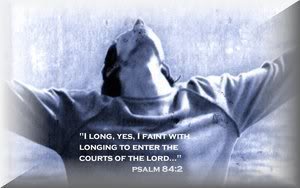
My soul longs, yes, even faints for the courts of the LORD; 
my heart and my flesh cry out for the living God" 
Psalm 84:1-2  (NKJV)

Psalm 84 expresses the thoughts of a Worshipper who wants to go to Jerusalem for a feast [there are three annual feast - Exodus 23:17; 34:23] but cannot. His great desire was not to go to Jerusalem solely to observe a holy day. Instead, he wanted to go to the temple to meet God. "Even the sparrow has found a home, and the swallow a nest for herself, where she may lay her young" (verse 3). In other word, God's Living house is to his soul what a nest is to a swallow - a place of rest and security and satisfaction. The psalmist even envies the priests. "Blessed are those who dwell in Your house; they will still be praising You" (verse 4). Outsiders were not allowed to live there, and they were limited in where they cold go inside. Only the priests could enter the Holy of Holies.

Today, we have the privilege to fellowship with God without going through a priest. Do we have a desire and a hunger to worship Him? Does our hearts cry out for the living God. Or are we happy for an excuse to be somewhere else from God's house? The important thing is that we have a heart devoted to the LORD, a spiritual "appetite" that cries out for nourishing fellowship with the LORD. How easy it is for us to take for granted the privilege of worshipping "the living God," [see also Psalm 115:1-8] a privilege purchased for us on the cross.

May we pray and hunger like David, "As the deer pants for the water brooks, so my soul pants for You, O God. My soul thirsts for God, for the living God" (Psalm 42:1-2).
Jesus said, "Blessed are those who hunger and thirst for righteousness for they shall be filled" (Matthew 5:6).

Be inspired and blessed with this song:

Sunday, January 27, 2013

A SALUTE TO THE AVERAGE WORSHIP LEADER

Today I want to salute the average worship leader.
Why? If YouTube videos and conference worship bands are any indicator, we’re unintentionally (I trust) cultivating an understanding of musical worship and its leaders that draws more from rock concerts and Entertainment Tonight than biblical principles.
We can start thinking that the “best” corporate worship context is characterized by bright stage lights, a dimly lit congregation, Intelli-beams, fog, high end musical gear, multiple screens, moving graphics, and loud volumes. We can start to think the ideal leader is good-looking, sings tenor, plays a cool instrument (usually guitar), sports hip hair, and writes songs. And by the way, the band members and vocalists should be near studio quality, if not actual studio musicians, and look pretty good themselves.
To be clear, I thank God for godly, good-looking, musically gifted, well-known leaders who are simply seeking to be faithful and bring glory to Jesus. I know a number of them. And God is all for skill and excellence when we bring our musical offerings to him (Psalm 33:31 Chronicles 15:22). Technology isn't evil (although it inherently affects the message we’re communicating).
A Concern over emphasizing or consistently focusing on technology, skill, and excellence can leave most us with a nagging feeling that our musicians, our leaders, our equipment, and our songs are never quite good enough. We resign ourselves to the thought that we'll never be as successful, used, or important as the people we see on YouTube and at conferences. Or we breathlessly pursue the trappings and externals of “modern worship,” attaching biblical authority to very cultural practices.
That’s why today I want to salute the average worship leader.
Are You an Average Leader?
By average I don’t mean mediocre or lazy. Just normal. Because that’s what most of those leading in churches today are. Normal. Maybe you can relate to some of these “average worship leader” characteristics:
  • Your musical training, if any, was years ago.
  • No one wants you to sing lead on an album, but you get the melody pretty much in tune.
  • Your vocal range is a little over an octave, but almost always lower than the recorded key.
  • You prepare and rehearse in the midst of a full time job and responsibilities at home.
  • You and some of the other musicians could do better with your dieting.
  • Sometimes it’s hard to figure out the chords or strum pattern on a song.
  • Your sound system has been pieced together over the years and still works. Most of the time.
  • Your choices for lighting are ON or OFF.
  • Twice a year you lead surrounded by a set for “Phantom of the Opera” or some other school play.
  • You have good folks on your team who don’t have a ton of time to practice or rehearse during the week.
  • The ages of your team members range from 14 to 56.
  • Some people in the church love what you do, some aren't crazy about what you do, and some aren't sure what you do.
  • You don’t even try to keep up with the gazillion worship albums released every month.
Here’s why I want to honour you. God sees your labours  And he says they’re not in vain (1 Corinthians 15:58). “For  God is not unjust so as to overlook  your work and the love that you have shown for his name in  serving the saints, as you still do” (Hebrews. 6:10).
God seems to favor doing his work through the weak and the few (1 Corinthian 1:26-28Judges 7:2-8Deuteronomy 20:1-8Matthew 15:32-28). That’s why I think average worship leaders play a significant part in God’s purposes to exalt his Son throughout the world.
Don’t Forget
While there’s never anything “average” about leading people to exalt the glories of Christ through music and the Word, we can always grow. So to encourage you and spur you on, here are a few thoughts:
  • It can’t be said too frequently that while God can use technology, skill, and excellence, he doesn't require them
  • What every leader has to offer people is the Gospel, God’s Word, and the Holy Spirit, working through redeemed sinners, us.
  • The same God who seems so present in a crowd of 10,000, is just as present in your church of 113.
  • The Holy Spirit doesn't need a dark room or dramatic lighting to reveal Christ to people. He’s been using natural light quite effectively for thousands of years.
  • We’re responsible for the resources we have, not the ones we don’t have (2 Corinthians 8:12).
  • Being average doesn't mean we can’t get better through practice, evaluation, and hard work.
  • Being average doesn't give us freedom to uncharitably judge or fail to learn from those who have greater gifts and opportunities than we do. 
  • Average musicians can be as self-sufficient as gifted ones, which should motivate us to pray consistently. 
  • The goal of our labours is not success or popularity, but faithfulness.
So if you fall into the category of the average worship leader, I want to thank you for your labours and encourage you to keep growing. God is using you in more ways than you can imagine to build his church and bring glory to his Son.
And because Jesus is the perfect worship leader who paid for all our sins and failings through his substitutionary death on the cross, we can look forward to the day when every faithful leader, average or not, will stand before the Father and hear him say, “Well done.”
An extract by Bob Kauflin @ www.worshipmatters.com

Sunday, January 20, 2013

WORSHIP IN SPIRIT AND IN TRUTH (PART 4)


A time will come, however, indeed it is already here, 
when the true (genuine) worshippers will worship the Father 
in spirit and in truth (reality); for the Father is seeking 
just such people as these as His worshippers.
John 4:23 (Amplified)

What kind of worship is God looking for? Our answer is found in John 4:23. Here Jesus speaks specifically of TRUE WORSHIPPERS. Does Jesus' statement implies that there are also false/vain worship? Yes it is possible to be "doing worship" and yet not meeting what God is looking for. So what then is TRUE WORSHIP
1) TRUE WORSHIPER WORSHIPS THE FATHER.
Jesus did not walk up to the Samaritan woman to ask her to sing two fast songs and three slow songs or clap and raise her hands in worship. TRUE WORSHIP is about having a deep personal relationship with the Father. The Samaritan woman thought she knew about worship when she told Jesus about worshiping on a certain mountain while the Jew must worship in Jerusalem (John 4:20). Similarly today, we may define worship worship as a certain style or platform. But Jesus said, " True worshipers will worship the Father." This is the HEART OF WORSHIP! 
Jesus gives us a warning when He directed Matthew 15:8-9 to religious leaders:
"These people draw near to Me with their mouth, and honor Me with their lips, but their HEART is far from Me. And in vain they worship Me, teaching as doctrines the commandment of men."
The Greek word for "vain" means fruitless and egotistic. Worship based on the traditions of men while ignoring the commands of God. Everything may looks good outwardly but they are just performances without HEART!
2) TRUE WORSHIP - WORSHIP IN SPIRIT AND IN THE TRUTH
What does it means to worship the Father in Spirit and in Truth?
a) IN SPIRIT: 
- To worship God from the HEART - Deuteronomy 6:5-6
"Love the LORD your God with all your HEART and with all your soul and with all your strength. These commandments that I give you today are to be in your HEARTS."
- To engage our spirit in worship because God is a spirit  - John 4:24
"God is spirit, and His worshipers must worship in the Spirit and in truth."
This means that we can engage worship with our spirit in worshiping God (more that our physical body or dependence of musical instruments or comfortable environment) anywhere and anytime.
"Regardless of how magnificent the musical moment are, unless your HEART is fully engaged in the worship expressed, it is still only music." - Darlene Zschech
b) IN TRUTH: 
- To worship God as He directs in His WORD - Deuteronomy 5:32-33
"So be careful to so what the LORD your God has commanded you; do not turn aside the right or to the left. Walk in OBEDIENCE to all that the LORD your God has commanded you, so that you may live and prosper and prolong your days in the land you possess."
God is looking for a people who will live a LIFESTYLE OF WORSHIP walking in OBEDIENCEin accordance with His WORD
"If you cannot worship God in the midst of your responsibilities on Monday, then it is very unlikely you were worshiping God on Sunday!" - A.W. Tozer
"A worshiper is one who is intimately acquainted with and have a daily relationship with God exhibited through OBEDIENCE." - John W. Stevenson

Sunday, January 13, 2013

WORSHIP IN SPIRIT AND In TRUTH (PART 3)

"The true worshippers will worship
the Father in spirit and truth;
for the Father is seeking such to worship"
John 4:23 (NKJV)

The greatest pleasure of the Christian life is WORSHIP, though we scarcely realize it until we've dive in WHOLEHEARTEDLY. We often approach it at first as an obligation. We're fairly self-focussed, and it's hard to turn our HEARTS toward God. But if we do, IN SPIRIT AND IN TRUTH (with zealous inspiration and according to who God really is), we find in expressible delights. Jesus seeks to turn us, like the woman at the well, into WORSHIPPERS with substance rather than WORSHIPPERS of ritual. How do we make that change?
Many of us ask God this question: "What is my responsibility toward You?" While not a bad question, there is a better, more HEART-WARMING question: "What can I offer You to show my devotion?"
Do you see the difference? The first question presupposes a requirement we must meet. It almost assumes that there will be a minimum standard, and after having met it, we will cease our "God-ward" activity and resume our "self-ward" obsession. The second question presupposes a desire to express LOVE and DEVOTION. It assumes that there can never be enough we can offer Him, but whatsoever we can find to offer, we will. There is no "self-focus" in it at all; it is entirely enamoured with God.
Jesus would have us not ask which requirement we are to fulfill, but what more of ourselves we can offer Him. When we look for our required obligation, we do not WORSHIP IN SPIRIT, because the Spirit of God would not inspire us to fulfil quotas of devotion. And we do not WORSHIP IN TRUTH, because we understand God's worth. He is worth all we are, and more!
Blessed is the WORSHIPPER who can truthfully - and with pleasure - say to the LORD: "What can I do for You? You name it, it's Yours. Whatever I can offer You, please let me." This is the kind of WORSHIPPER the Father seeks.
(an extract from: At His Feet Devotion by Chris Tiegreen)


Sunday, January 06, 2013

WORSHIP IN SPIRIT AND IN TRUTH (PART 2)

"I Will Bless The LORD At All Times;
His Praise Shall Continually Be In My Mouth"
Psalm 34:1 (NKJV)

What would happen if we decided to let every thought and every breath bless the LORD? Imagine the result if His name were affectionately on our lips as we lay down at night, as we turned over in our sleep, as we awoke in the morning and as we went about our daily business. Would such a perspective radically change our hearts? Probably. Would it change our world? It's likely. Any time in the Bible someone gives himself to worship, God does amazing things through that person. Blessings abound. God's work done. He is glorified.
What prevents us from such a pervasive sense of His worth? Are our schedules just too busy? Or is it deeper than that? Perhaps it's a suspicion that He hasn't been as good to us as Scripture declares that age is. Or maybe it's a subtle resentment that He has not paved our paths with gold and has allowed us to taste the bitter trials of life.
Whatever reasons we can come up with, we should ask ourselves if a worship-filled heart is worth sacrificing to the gods of busyness, apathy, and disappointment. If we really got a glimpse of God, we would never be too busy; we would never be too apathetic; and we would never be disappointed with His will for us. We would understand that underlying everything we go through and every responsibility we're given is the loving hand of a God who is leading us closer to Him. The end result is a greater blessing than and earthbound human can possibly imagine.
The angels surrounding God's throne cry put day an night, "Holy, Holy, Holy is the LORD Almighty; the whole earth is full of His Glory" (Isaiah 6:3). Perhaps we were not created with exactly the same role as those angels were; but then again, perhaps they are pictures of the praise all creatures - including us - owe Him. We at least have a similar purpose: to honour God and ascribe glory to Him. What prevents us? Nothing should. What would result? Everything our heart truly desires.
(An extract from: Worship The King by Chris Tiegreen)

Tuesday, January 01, 2013

WORSHIP IN SPIRIT AND IN TRUTH

God Is Spirit, and those who worship Him 
must worship in spirit and truth
John 4:24 (NKJV)  
What is your worship like? Is it a Sunday ritual or a frenzied emotion that you can put on and take off? Is it limited to one style of music or a particular church? Most important, is it more than skin-deep?
Considering the central role of worship in the life of a human being - it is our entire reason for being, as well as the eternal activity of the saints in heaven, according to the WORD - we might do well to consider what God wants it to be like. Does He prefer informal or formal? Ritualistic or spontaneous? Noisy or quiet? Dignified or recklessly passionate? Nearly everyone has an opinion on these alternatives, but they aren't really the HEART of the issue. What God desires most has less to do with how we express our worship than with the spirit behind it. In our adoration of our Creator, God seeks inspiration and integrity and a spirit of sacrifice. He wants our outward expression to match our inward attitudes. He wants us not to worship ignorantly, but to know Who He is. He wants it to be real.
That's hard for us. We fall into error so easily: We're either too emotional or not emotional enough, too rigid or too unstructured, too self-conscious or not self-aware enough. Most of all, we're apt to turn a worshipful heart into a routine behaviour in the blink of an eye. What was sincere devotion yesterday is a performance for God's approval today. What was once an act of passion is now an act of obligation. Our HEARTS can grow cold faster than we ever thought.
Worship defines the relationship between God and His people and touches every aspect of our existence. 
God seeks those whose worship emanates from deep within. He desires legitimate praise and integrity between the HEART and mouth. He wants to be the One we treasure most. Most of all, He wants you! 
As we step into the New Year, let us consider the priority the Word of God places on TRUE WORSHIP - Jesus' declaration that REAL WORSHIP is what God is after - to WORSHIP HIM In SPIRIT AND IN TRUTH.
(an extract from Worship The King by Chris Tiegreen)